
Architecting a Remote Design Team
# Culture, systems, and progression at 90POE.
At a glance
From scattered contractors to a cohesive in-house team.
Hired to replace the exiting Chief Design Officer, I designed the entire function from the ground up — its culture, its processes, and its systems.
The challenge
I faced a fragmented, contractor-led model with no C-level leadership, deep design silos, organisational ambiguity, a chaotic tech stack, and no clear career progression to attract or retain talent.
My role
Lead Designer / Head of Design (Player-Coach), responsible for all hiring, creating the Design Charter and Career Ladder, building the design system, and day-to-day leadership and mentorship.
The impact
Transformed a scattered group of siloed designers into a single, cohesive, and resilient in-house function. Eliminated ambiguity, boosted productivity, and established a clear path from Junior to Lead.

Maritime SaaS
Design the function, not just the hiring plan
When I was hired to replace the exiting Chief Design Officer, my task wasn't just to lead the design team; it was to build one. The company was in the middle of a profound shift, moving away from a flexible, contractor-led model to building a permanent, in-house team, and doing it all without a C-level design leader in the building. My approach wasn't simply to go out and hire a few designers. It was to intentionally design the entire function from the ground up — its culture, its processes, and its systems.
Forge a shared identity with the 90POE Design Charter
When I joined, the design team was operating under a structure that had led to a fair bit of organisational ambiguity. The problem really hit home for me when a talented designer confided that she believed her Product Manager was, for all intents and purposes, her boss—dictating not just what she worked on, but how she should do her job. This wasn't a minor issue; it meant we had designers with conflicting loyalties, and a constant, nagging confusion over who actually owned the design. My approach wasn't to lock myself in a room and emerge with a set of stone tablets. Instead, I kicked off a collaborative, hybrid process to create the 90POE Design Charter from the ground up.
The in-person foundation
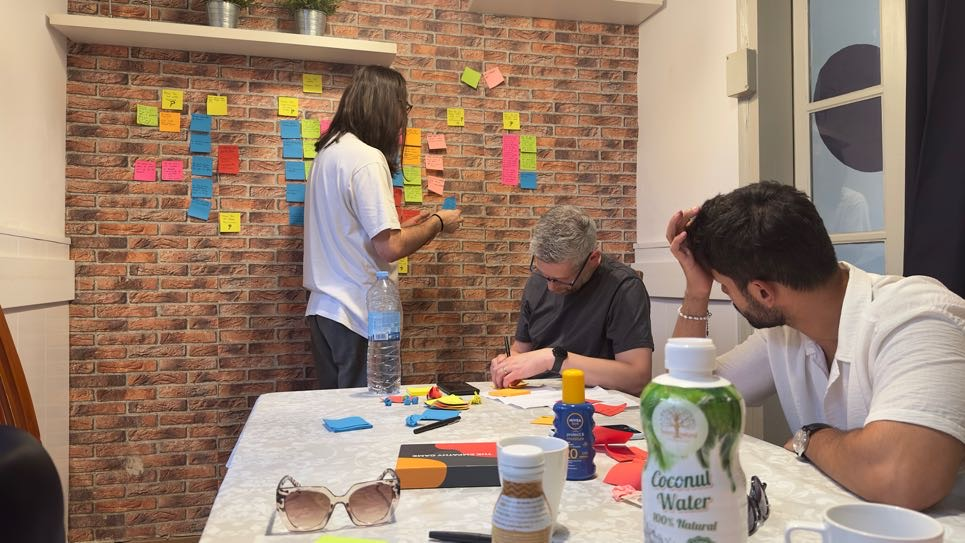
The work began at our team meetup in Barcelona. We rented a large Airbnb, using a mountain of Post-it notes and affinity mapping to work through the core pillars of a charter.
Empowering remote inclusion
To make sure the process wasn't just a perk for those who could travel, I appointed a deputy from our remote team to lead a parallel workshop using a collaborative FigJam board.
Synthesising a unified vision
Finally, I got the entire team together to hammer out the final details. The result was a charter that was a true reflection of our entire team's values.
Parallel remote FigJam workshop and final 90POE Design Charter
A pragmatic strategy for a unified design system
When I took over, the very idea of a design system was met with a healthy dose of scepticism. Past attempts had been expensive failures, leaving behind a junkyard of fragmented tools and abandoned code. We had designers working in Sketch, a custom UI library called Coral that nobody owned or dared to touch, and a growing chasm between the AntDesign used for our desktop app and the old Material library on mobile. My solution was to design a proper, scalable 'Assignable Entity' framework and codify it in our revived Coral design system. The cornerstone is a new, intelligent UserTag component with clear visual states for Active, Suspended, and Deleted users that respects our complex permissions model.
Before / Fragmented stack
Sketch files, an unowned Coral UI library nobody dared touch, AntDesign on desktop, and a legacy Material library on mobile.
After / Assignable Entity framework
Codified in the revived Coral design system around an intelligent UserTag component with Active, Suspended, and Deleted states respecting complex permissions.
The revived Coral design system: UserTag states for Active, Suspended, and Deleted users aligned to the permissions model.
Build a resilient team with a product design career ladder
After a major leadership shuffle, I was hired to replace the exiting Chief Design Officer and lead the design function. This created a huge hole where a sense of direction should have been. To attract the kind of senior talent we needed—and to stop them from walking out the door six months later—I had to give them a clear and compelling reason to stay. My answer was to build the 90POE Product Design Career Ladder from scratch. It wasn't about creating a bunch of fancy new titles; it was about providing a practical, common-sense framework for growth across four distinct levels—Junior, Mid, Senior, and Lead—each with brutally clear expectations for skills, behaviours, and impact.
Four distinct levels—Junior, Mid, Senior, and Lead—with plain-English expectations for skills, behaviours, and impact.