Omniverse
# Connecting customer conversations with commercial context.
At a glance
Delivered on time.
Falcon retired.
An in-house support platform replaced the third-party subscription and connected social conversations with THG’s customer and operational data.
The challenge
Replace Falcon, a costly social support platform disconnected from THG’s customer and operational data, without missing the delivery deadline.
My contribution
Led internal-tools design, shaping the customer service platform with engineering and product stakeholders.
The approach
Separate manager and advisor workflows, prototype stacked cards in ProtoPie, and make permissions intent-first.
Design for the business behind the storefront
THG’s internal tools supported the operational backbone of a large e-commerce business: warehouse management, trading, campaigns, brand configuration, inventory, pricing, courier tracking, and anti-fraud. The customer service platform was one part of that wider portfolio.
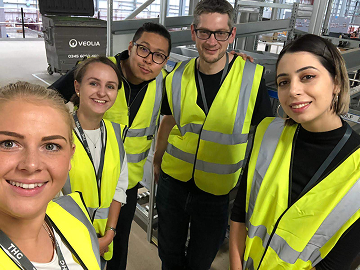
Design and product were stretched across multiple projects and locations. My task was to create clarity within that complexity—connecting the customer-facing conversation to the systems that could explain and resolve it.

Turn individual initiative into a shared direction
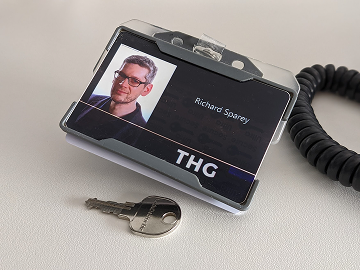
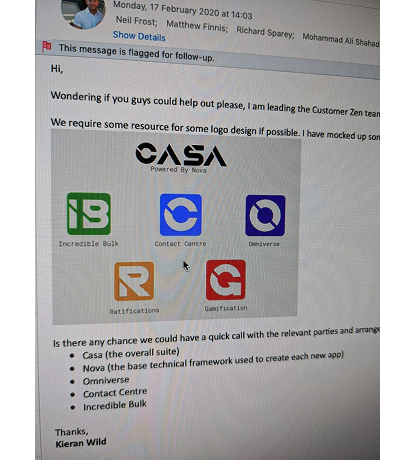
Engineering teams had already started solving problems before design capacity was available. A request from the customer service lead developer for help with CASA suite logos made that gap visible.
I treated the existing work as evidence of initiative, not a failure of effort. The opportunity was to give teams a shared design direction and a more useful way to collaborate.
Ground Falcon without losing the service
The business had already decided that Falcon needed to go. It was costly and operated as a data silo: support advisors had to move between systems to find customer, order, and delivery information.
The design challenge was not simply to reproduce a social inbox. It was to give advisors the context needed to respond, while giving managers a practical way to triage the incoming work.
A manager is not an advisor
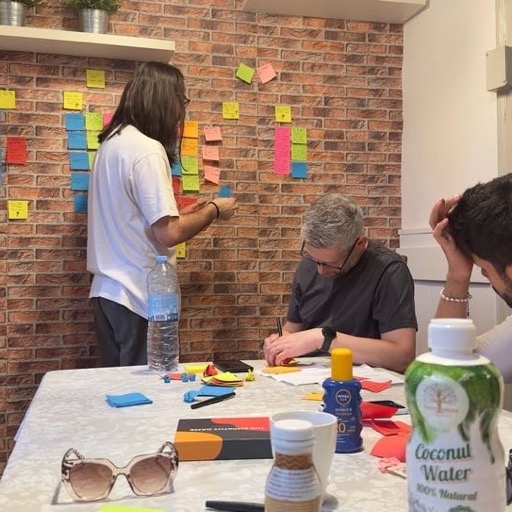
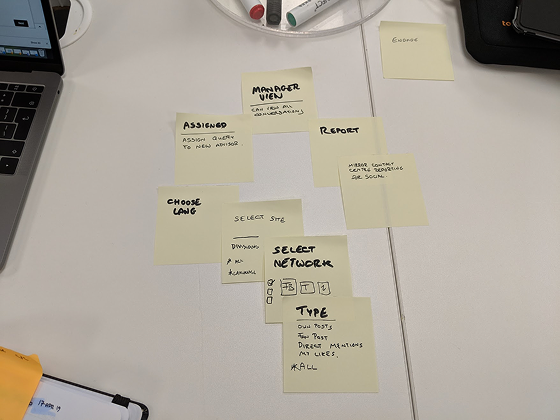
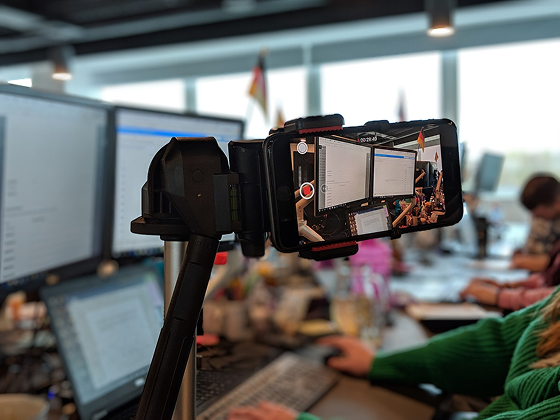
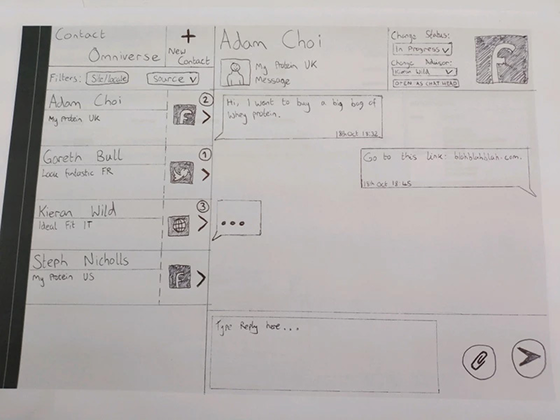
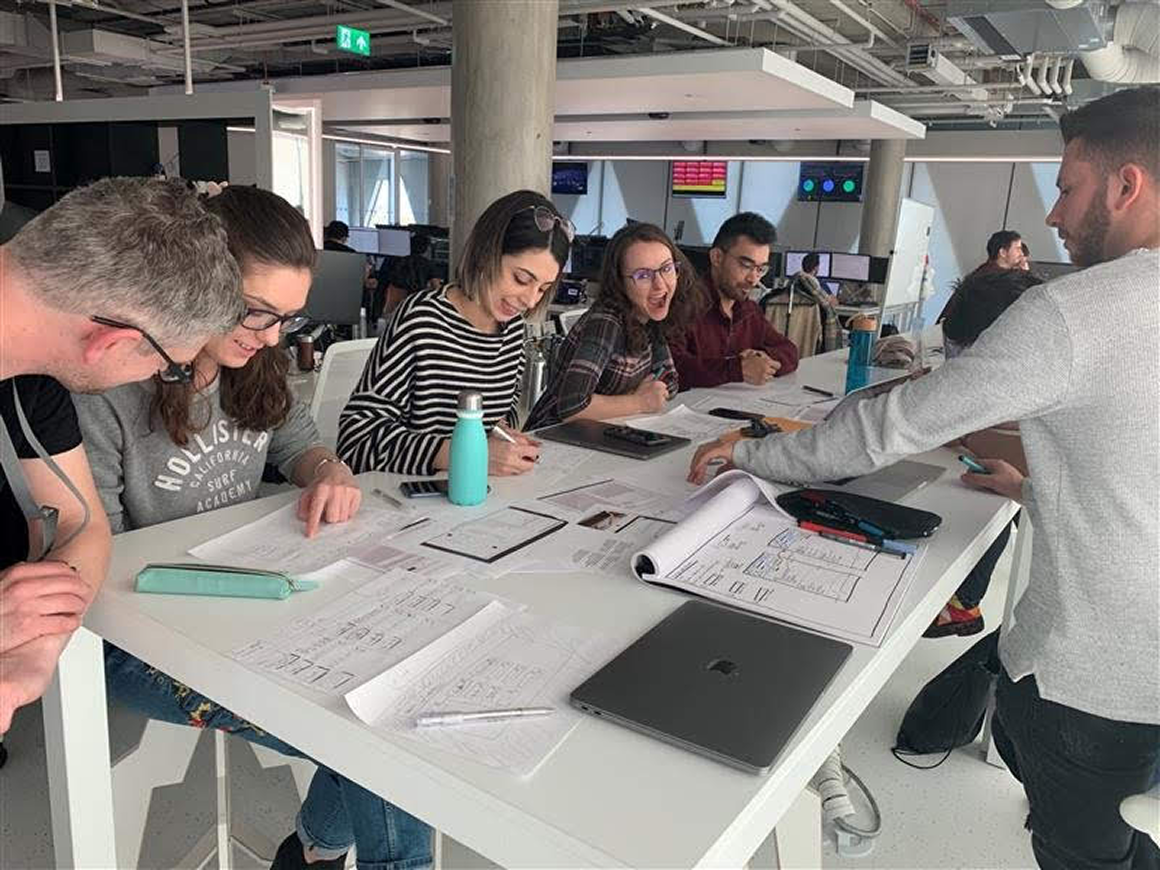
The development team’s early sketches assumed that managers and advisors needed essentially the same experience. In workshops, I mapped the actual work and separated the two roles.
Advisors needed to hold a customer conversation and investigate the details. Managers needed to assess demand, prioritise it, and direct the team. That distinction became the basis for the interface and later proved essential to the MVP.
Advisor view
Read, investigate, and respond with the customer’s context close at hand.
Manager view
Triage demand, coordinate the queue, and allocate work across the team.
Shared foundation
Connect both roles to the same customer and operational data.
Keep the conversation and the context together
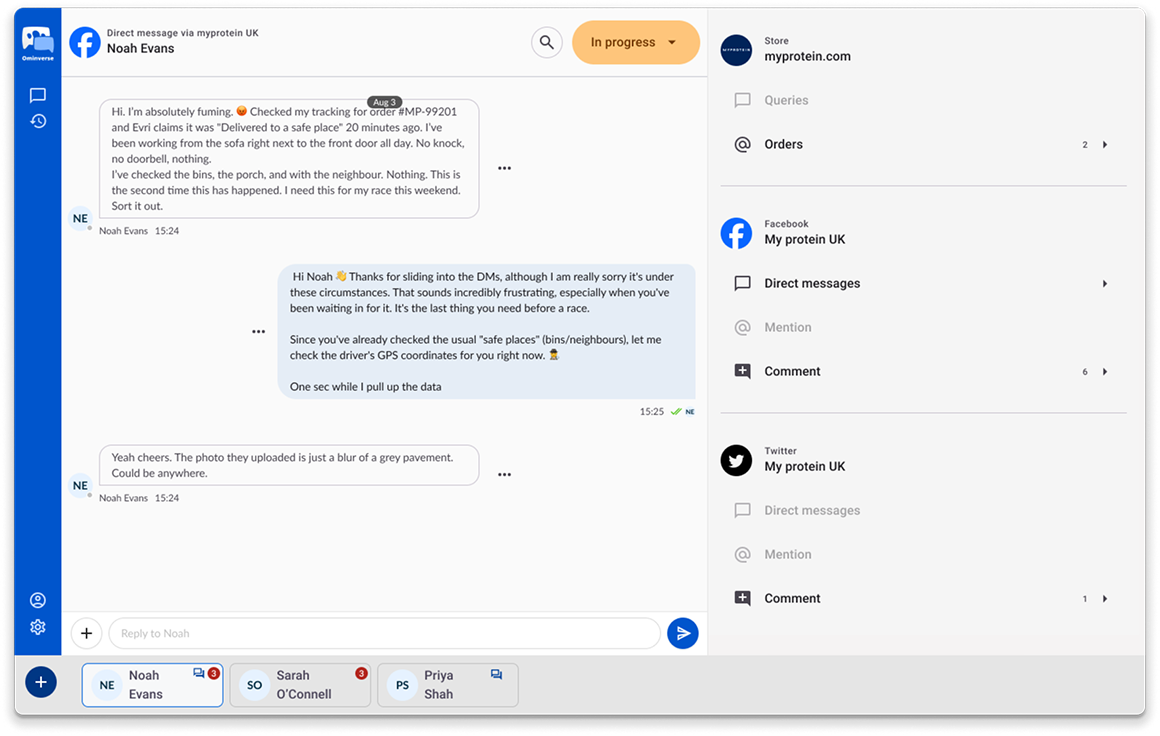
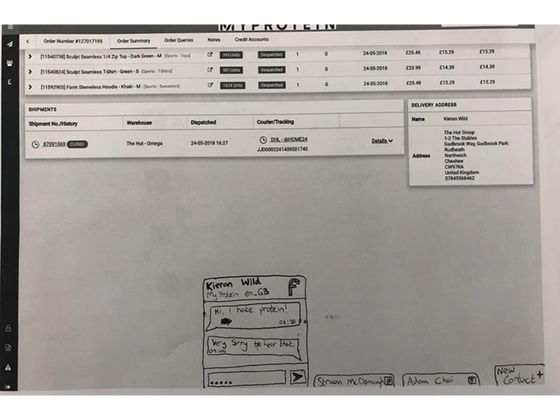
In Falcon, a delivery query could send an advisor through several separate tools before they could reply. Omniverse connected the social feed with THG’s internal data so that customer history and operational information could be investigated in the same workspace.
The stacked-card interaction helped manage multiple conversations without discarding the current context. I used high-fidelity ProtoPie models to explore that interaction before implementation.
Make the MVP trade-off explicit
The original ambition included an automated queue that would rank incoming messages using business rules, including the visibility of public complaints. Building that prioritisation engine was too large an undertaking for the deadline, so it was deferred from the MVP.
This made the manager workflow more important, not less. Managers still needed to prioritise and direct the work while the team delivered the core replacement for Falcon.
Keep in the MVP
A working support platform with connected context and manager-led triage.
Defer deliberately
Automated prioritisation required more engineering work than the release window allowed.
Preserve the direction
The interface still needed to support a more systematic queue in a future iteration.
Start with the change the manager wants to make
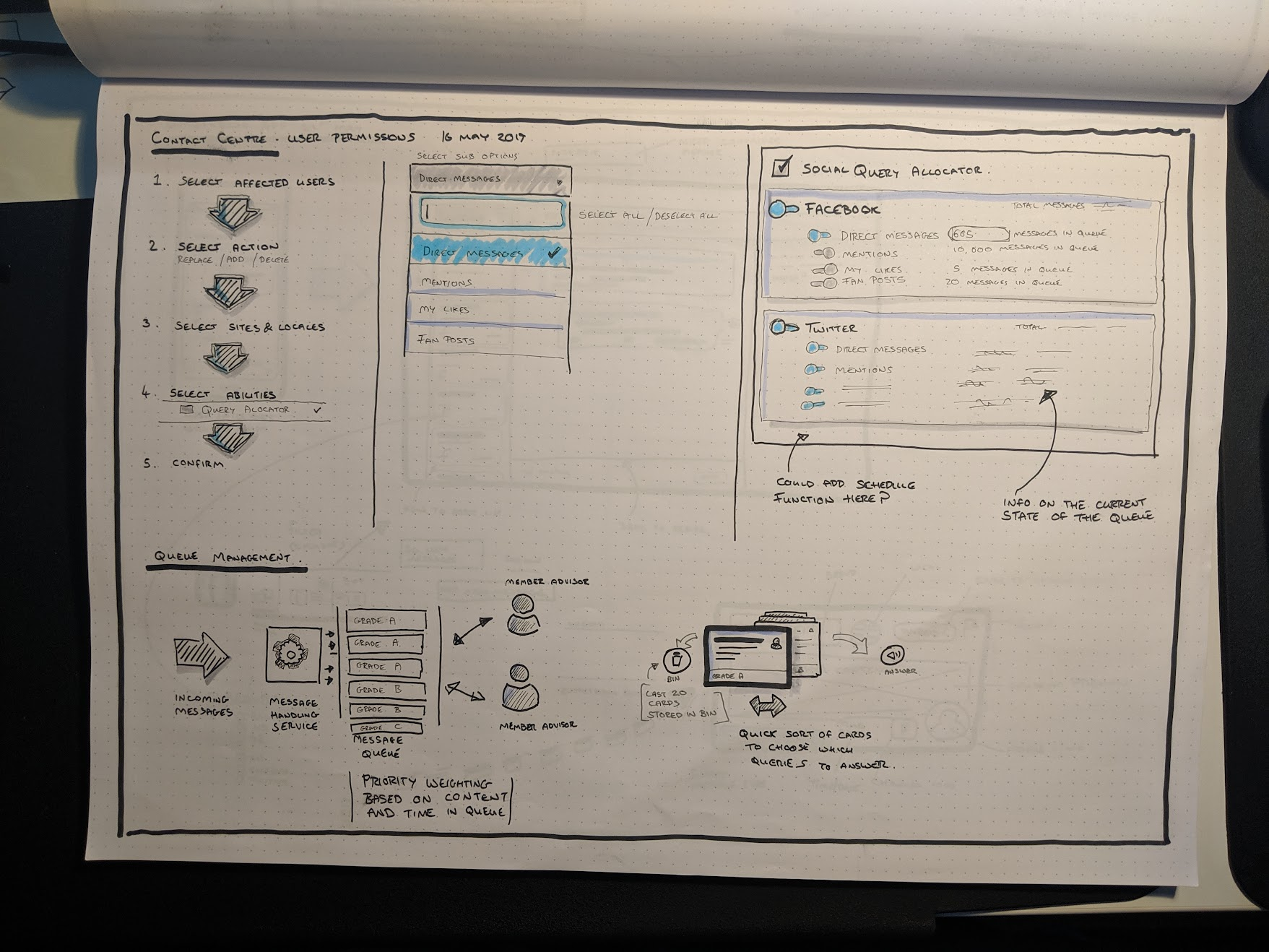
Permissions had to work across many websites, locales, and social channels. My first model asked managers to choose a user, then a site, then a permission, and only then decide whether to add, remove, or replace access.
The sequence followed the data model, but workshops showed that managers started with the intended change: “I need to replace this person’s permissions.” Moving Add / Remove / Replace to the beginning aligned the flow with that mental model and simplified the interaction.
Before / Data first
User → Site → Permission → Action
A logical sequence that delayed the manager’s actual intent until the last step.
After / Intent first
Action → User → Site → Permission
Start with Add, Remove, or Replace, then gather the details needed to carry out that change.
Deliver the replacement. Then improve the experience.
Omniverse was delivered on time and the Falcon contract was terminated. That was the immediate business outcome: a working in-house platform replaced the third-party subscription and connected social support to the rest of THG’s data.
The confirmed commercial milestone was the contract termination. Exact financial savings and post-launch productivity figures are not available.
Delivery
The core platform shipped within the required timeframe.
Integration
Social support could work with customer and operational context from the wider business.
Commercial outcome
The Falcon subscription was retired; the exact financial saving is not stated.
Commercial outcome
The Falcon subscription was retired; the exact financial saving is not stated.
The next question was the advisor’s experience
The first release solved the replacement problem. The next phase was to improve the day-to-day work of support advisors and assess whether those changes made their jobs measurably better.
Observation and direct feedback informed the interaction design. Further optimisation and evaluation were next steps—not results retroactively attributed to the initial release.