On Design Feedback, and Why Most of It Is Ambitious But Rubbish
# Replacing 90-minute 'visibility' meetings with focused, evidence-based design critiques
In 30 seconds
From theatre
to craft.
Great critiques aren’t X Factor for pixels. They’re structured, safe, evidence-based conversations that make the work better.
Share work two days early with problem, user, and specific help needed.
Ten minutes of silent sticky-note review stops the loudest voice from hijacking the room.
Anchor feedback to shared personas and outcomes—never personal taste.
There are many soul-destroying things in the modern world. Take my attempts to assemble flat-pack furniture, for instance. I’m given a tiny Allen key, a set of instructions rendered complete gibberish by Google Translate. My only real tool is a stubborn refusal to admit defeat to my better half. Or spending the entire afternoon on hold, listening to the same 10 seconds of a tune looping round and round, broken by the occasional reminder that ‘lines are busier than usual’ and ‘my call is important’, only to be cut off the second someone finally decides to pull their finger out and answer the phone. But as bad as all of this sounds, none of these things, not one, is quite as spirit-crushing as a badly run design critique.
When I joined maritime tech firm 90POE, my first task was to figure out the rules for my new reality: a world of multiple product streams, remote teams, agile, and Minimum Viable Products. My remit was to build out the design team, and being remote meant we could source talent globally. The challenge, of course, is that you can’t just throw a new, global team in a room to build trust and a shared culture. You have to intentionally expose them to the fantastically complex world of maritime shipping and tackle the ‘inconsistency creep’ that was already underway.
My first attempt to solve all of this was a design team meeting with an ambitious goal: to forge a culture, build trust, and get a new global team up to speed, all in one go. Predictably, it became a 90-minute, round-robin affair for "visibility". Each design would throw up some work on the board and we’d all share what we were working on.
And for a while, it was useful. Genuinely. I could see real relationships growing in our new global team and a shared understanding of the platform starting to form. But as the team grew, the cracks began to show. It was like hearing the first few rivets popping off a hull plate under immense strain.
I knew the ship was sinking; I just didn't know when.
The meeting dragged on, and worse, the content was dreadful. Designers would just show up, unprepared, posting content during the meeting. They would talk us through their screens, describing UI elements, rather than explaining the problem they were trying to solve. In a desperate attempt to stop this, we gave each designer a countdown timer, as though a bomb would explode if they spoke for more than five minutes. It didn't work, of course. It just made them talk faster. The shared board for the meeting became a digital Wild West. Instead of focused work, you’d see a dozen pixelated screen grabs with no context, or worse, a screenshot of a busy calendar posted as a sort of ‘proof of life’. We even had screenshots of Slack conversations. Unsurprisingly, people, quite rightly, started finding excuses to miss it. There was always a ‘tight deadline’ or a ‘conflicting meeting’. Our last gasp was to shift it to once a fortnight, which is the corporate equivalent of putting a dying plant in a slightly bigger pot and hoping for the best. It had failed.
So after numerous iterations, reboots and talking around the issue, I made the call…. And scrapped it. It was time to go back to the drawing board.
A focused 30-minute critique
Sharing work early isn't a formality; it's a filter for quality. It kills the hot take.
We replaced it with a focused, 30-minute session that designers actually want to come to. A session with a single purpose: to make the work better. It’s so important, in fact, that attendance is no longer optional. In the bad old days, ‘being busy’ was a perfectly acceptable excuse. Not anymore. The only valid reasons to skip are that you’re on holiday or on a call with an actual customer. Otherwise, you’re there. The rules are brutally simple.
First, you share the work a day before the meeting. Not an hour before. Not during the meeting while fumbling with your screen share like a grandparent on their first video call. Two. Days. You must provide context: what’s the problem, who’s it for, and where, specifically, do you need help?. If you don’t do this, you can’t come in.
And why are we so militant about this? Because asking someone to critique a complex design they’re seeing for the first time is like asking a Chief Engineer to diagnose a critical engine failure by describing the funny noise it's making over a crackly satellite phone. It guarantees you’ll get lazy, off-the-cuff opinions because you’ve given them no time for deep, considered thought.
Then, when we all gather, the designer gets ten minutes on the clock. It's their opening statement. A chance to lay out the crime scene: to explain their thought process, the insane user insights that led them down this particular rabbit hole, and to point a flashing neon sign at the exact spots where they need help. It's basically them saying, "Don't tell me about the colour of the bonnet; I need to know if the engine is going to explode."
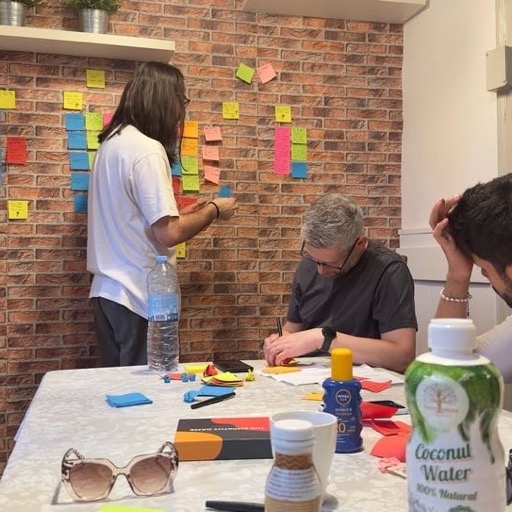
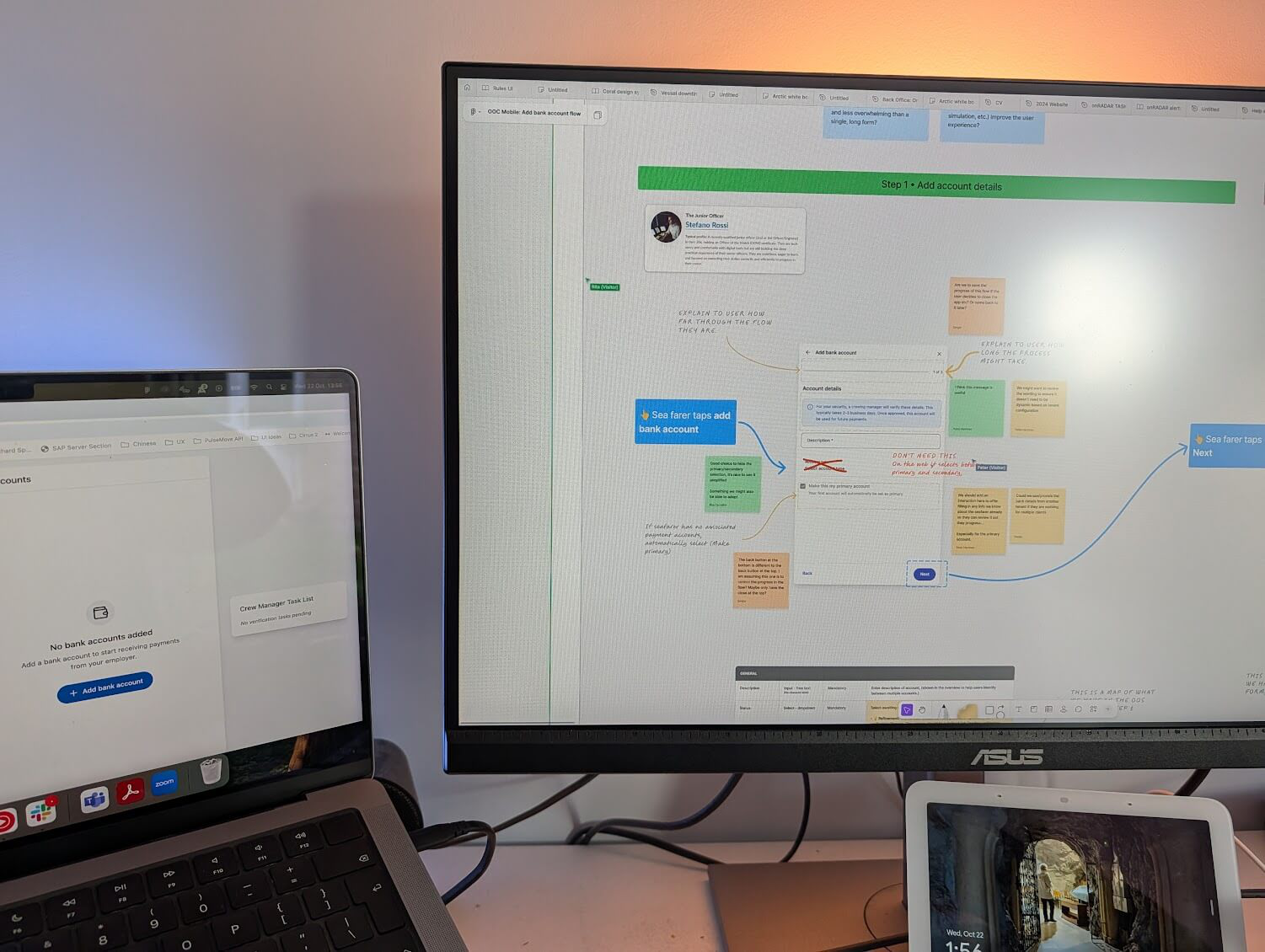
Only after that, when everyone is pointing in the same direction, do we do the most important thing. We all shut up. For ten solid minutes, not a word is spoken. Everyone explores the work and writes their thoughts on digital sticky notes.
Solves the problem
For when a designer has beaten a tangled workflow into glorious submission.
Don’t understand
A polite way of asking, “What on earth were you thinking?”
Tangential ideas
The stroke of genius that’s not really feedback, but is too good to lose.
The handbrake
Hold on, I think this is a problem—the iceberg everyone else is ignoring.
Ban opinions. Make it safe.
This silent, intellectual brawl is a magnificent invention, championed by the clever people at Google as part of their Design Sprints. They realised that to solve big problems quickly, you first had to stop the endless talking. It stops the conversation from being immediately hijacked by the loudest person in the room and gives everyone else a chance to think. Only then, when the dust has settled, do we actually talk. And that’s when the other rules kick in.
You ban all opinions. Liking is for puppies and ice cream. Instead, you anchor the entire conversation to objective principles, tying it back to our shared user personas and the metrics we've all agreed to care about. Does this layout help a sleep-deprived Chief Officer find the critical safety information in under three seconds during a storm?. Does this workflow prevent an overworked Accountant from making a catastrophic payment error?. If it doesn’t, it doesn’t matter if you “like” it. It’s wrong.
And you make it safe. Not “health and safety” safe. I mean safe to be a bit of an idiot. Safe to show a half-baked idea that might be brilliant, but is probably bonkers. Most organisations are spectacularly bad at this. They want innovation but punish failure. It’s like wanting a guard dog and then shouting at it for barking.
Of course, when you get a group of clever people in a room, they have a tendency to wander off. Someone will have a brilliant, world-changing idea that is completely and utterly irrelevant to the task at hand. For that, we have a ‘parking lot’. It’s a polite way of saying, ‘That’s a fantastic idea, but we’re trying to fix a leaky tap here, not redesign the entire plumbing of the nation. We’ll talk about it later.’
Four clear roles in the room
And making sure the meeting doesn't career off a cliff requires people with proper jobs.
Basically the head teacher, responsible for keeping time and stopping the loudmouths from dominating.
Owns the session; it’s their work, and we are there to help them.
Writes everything down so we have proof of what was said when the arguments start later.
Everyone else, whose only job is to turn up having looked at the work and provide useful feedback.
So, let’s stop “giving feedback.” Let’s stop pretending we’re all judges on some sort of X Factor for pixels. Let’s start having grown-up, evidence-based, collaborative conversations about solving real problems for people in high-stakes, pressure-cooker environments.
But let's be clear, this isn't design by committee. That way lies superficial feedback and a thousand rounded corners. At the end of the session, the designer owns the design. They are responsible for filtering through the feedback, making sense of it, and making the final call. The team isn't a board of directors; it's a support network. It’s a recognition that what we do is hard. Really, properly, fist-chewingly hard. And part of what makes it hard is that experienced designers often operate in the ‘it feels right’ realm. That’s not witchcraft; it’s intuition honed over years of practice. A good critique is the process of giving that gut feeling a backbone. It forces us to articulate our instincts in a language the business understands. And as a team, we’ve got each other’s backs.
Building a team that trusts each other enough to have these conversations is the most important safety feature you can install as a design leader. It's more valuable than any life raft.
What’s the worst feedback you’ve received?
What's the most useless piece of design feedback you've ever received? I'm betting we can compile a book.