Vessel downtime
# From incident logging to commercial clarity.
At a glance
From a stalled logger to a shared record.
Downtime, potential off-hire, and cost breakdowns in one working product—giving operational and commercial teams a shared record.

The challenge
Commercial decisions lived in conflicting spreadsheets. The stalled MVP logged downtime to tick a feature-list box, without connecting the operational response or financial consequences.
My contribution
I reframed the brief, partnered with the primary stakeholder, and built and tested the event, resolution, and cost models.
The approach
Separate event, response, and costs. Replace unstructured inputs with practical categories and link to existing safety investigations.
01 /
Downtime is a commercial problem
When a multi-million-dollar vessel stops moving, it doesn’t just create a technical fault—it starts bleeding money in one of two ways. Depending on the contract, hire income stops (off-hire), or voyage costs like fuel and port fees keep running while the ship earns no cargo revenue.
Recovering lost time can also increase fuel use and hurt environmental performance. The product needed to help teams understand those trade-offs—not simply record dates and locations.
One incident. Several decisions.
Technical teams need to restore the vessel. Operations must manage the knock-on effects. Commercial teams need a clear record of potential off-hire and the costs involved.
A complex, manual spreadsheet was doing the real work of connecting those perspectives. The proposed logger was not.
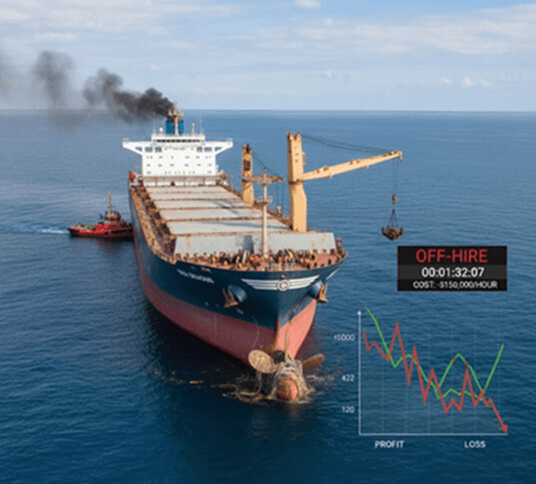
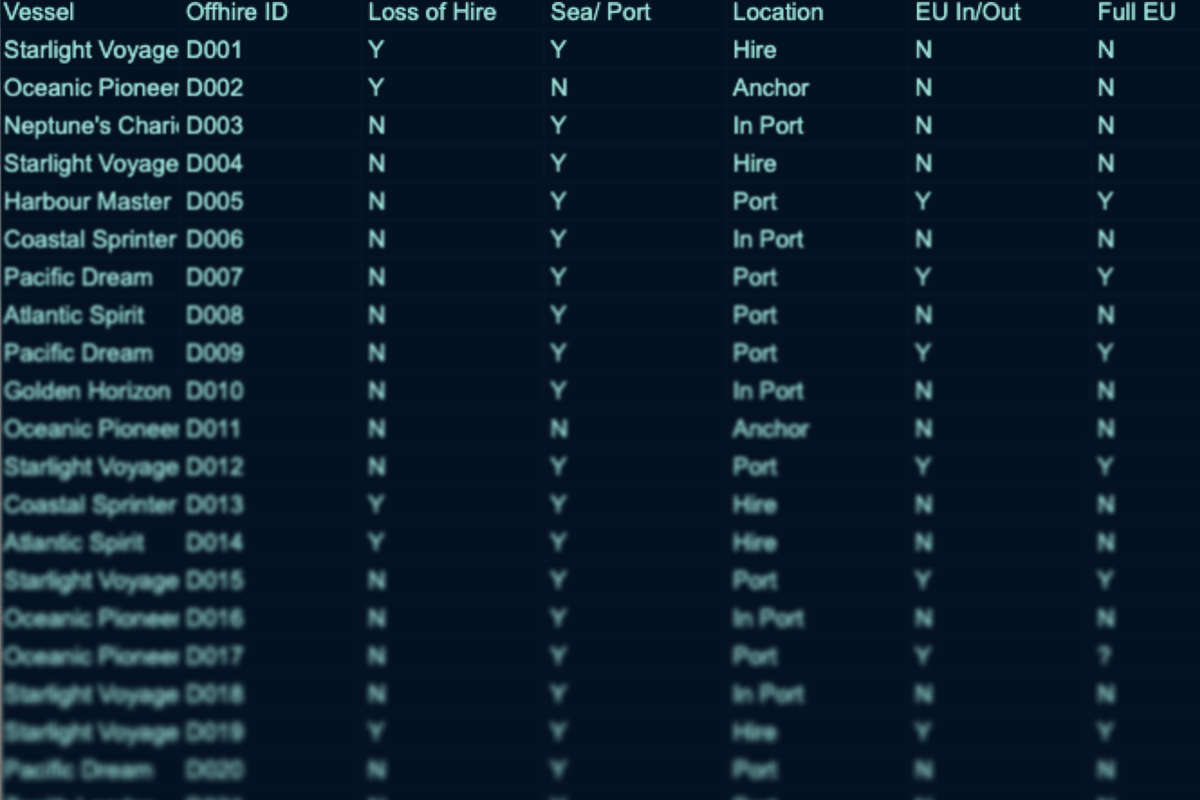
The existing spreadsheet combined downtime, off-hire, location, and cost information through manual entries.
02 /
Diagnose the gaps before finishing the form
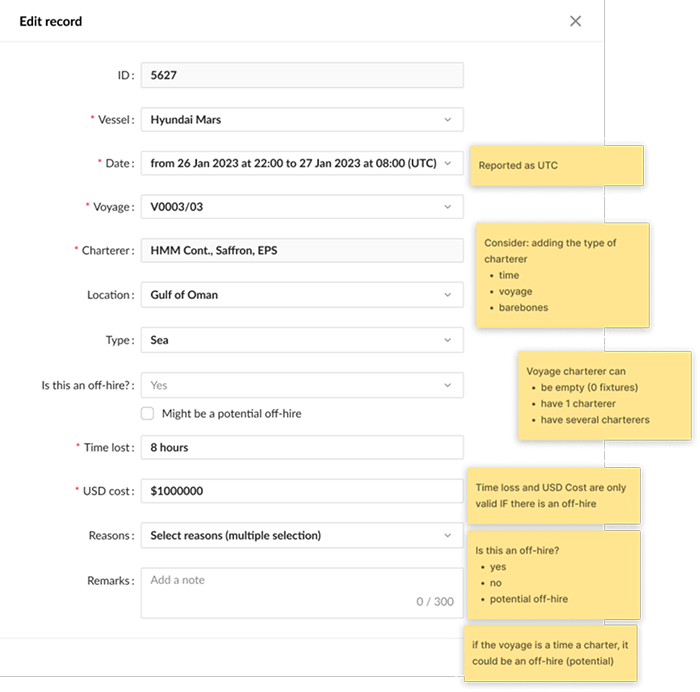
The inherited design was built to tick a feature-list box, not to replace the spreadsheets where commercial decisions lived. It captured dates and locations, while leaving teams to interpret contractual consequences and calculate financial impact elsewhere.
I treated the open questions and annotations as a starting point for discovery, not a specification to finish unchanged.
Consistent data
Free-text causes allowed useful detail, but made recurring problems difficult to categorise and analyse.
Appropriate responsibility
Technical staff needed a clear way to report an incident without also making unsupported commercial or contractual judgements.
Connected costs
The product needed to connect the event with its financial consequences, rather than leave the spreadsheet as the real working tool.
03 /
Structure the problem, then test it
Partnering with the primary stakeholder confirmed a crucial insight: the goal wasn’t just to log downtime—it was to understand it. That shifted the brief from a basic logger to three connected parts: what happened, how it was resolved, and what it cost.
The first beta still retained some free-text fields from the original brief. Putting a working version in front of the customer immediately exposed the remaining data-quality issues and gave us the evidence we needed for the next iteration.
Record the event
Capture what happened, where it happened, and the relevant time period.
Manage the response
Keep the steps taken to resolve the incident distinct from the initial report.
Understand the impact
Connect costs and potential off-hire without mixing them into the operational description.
Validate the workflow, not just the visuals
I used an interactive ProtoPie prototype in remotely moderated sessions over Teams. Think-aloud testing helped expose where the model was clear and where it still asked too much of someone working under pressure.
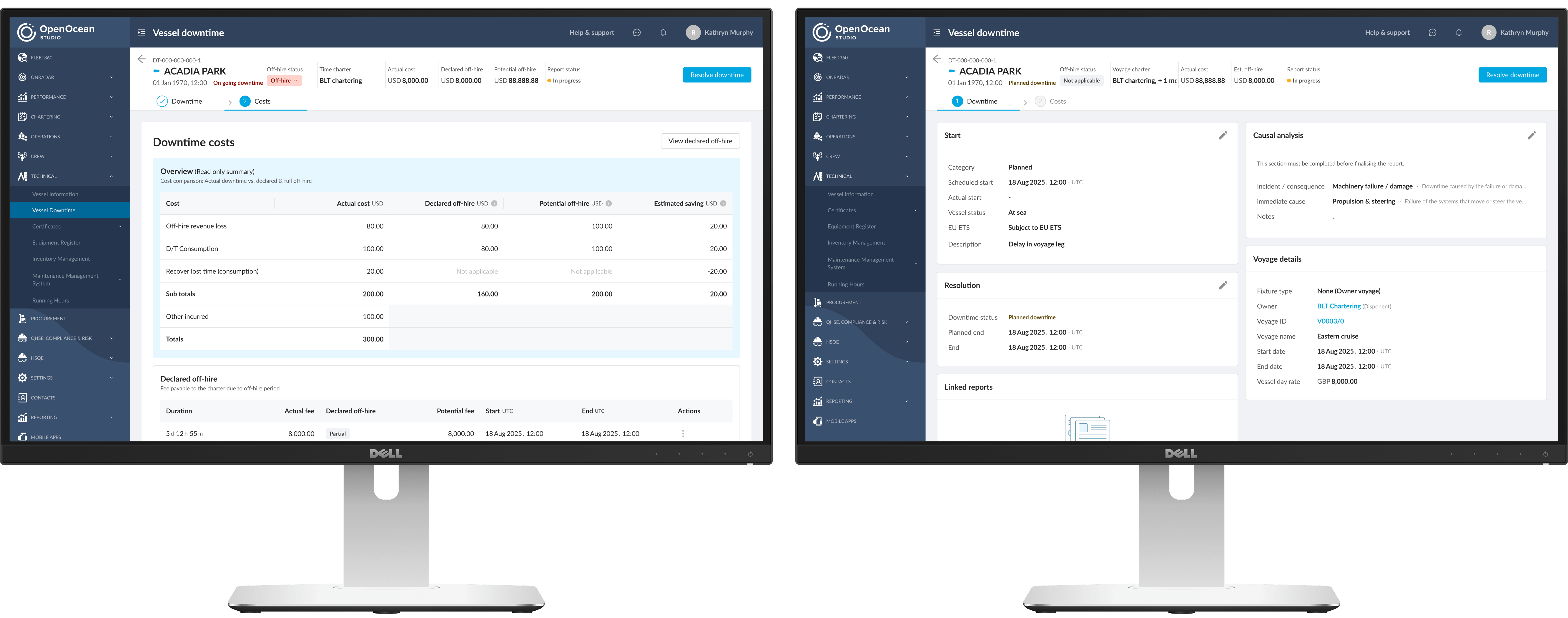
The event record and cost view show the separation between operational information and commercial consequences.
04 /
Use structure where it improves decisions
The beta confirmed that free-text fields produced inconsistent, unsearchable data. I replaced the noisy opening list with a clear choice at the start—Planned or Unplanned—helping superintendents schedule repairs when a vessel is off-charter rather than losing hire income.
Capture the immediate cause. Link the investigation.
The customer requested a formal cause-analysis workflow based on MSCAT. I prototyped a four-level hierarchy, then discovered the customer driving the request wasn’t using our HSQE module—they were using a competitor’s.
Rather than rebuilding an investigation tool they already had, we separated immediate reporting from deep analysis: two structured fields (Incident/Consequence and Immediate Cause) plus a URL linking directly to the safety investigation in their existing system.
Turn a list of numbers into a financial model
The same principle applied to costs. A two-level Type and Item structure gave each entry a clearer meaning—for example, a Port Costs category with a specific item beneath it.
This connected the commercial record to the downtime event and supported a more useful view of actual costs, potential off-hire, and estimated savings.
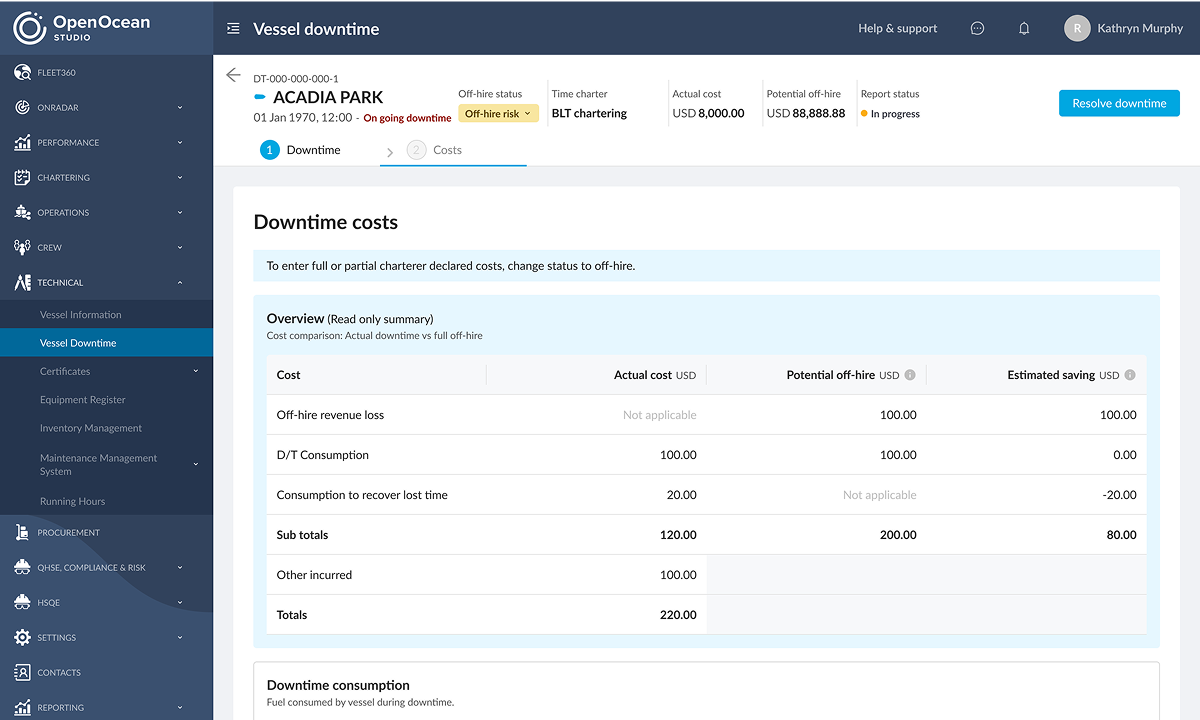
The delivered cost view separates actual costs, potential off-hire, and estimated savings. Values shown are interface example data.
05 /
From a logger to a shared operational record
The product gave teams a structured way to capture downtime and connect it with costs and potential off-hire. Operators could distinguish recurring causes, while commercial teams could inspect the financial consequences in the same context.
For operators
A more focused incident report and clearer categories for recurring problems.
For commercial teams
A shared record of costs and potential off-hire to support review and claims preparation.
For leadership
A foundation for analysing the cost of failures across vessels and incident categories.
Be clear about what was measured
I do not have validated post-launch percentages for this work. The delivery priority was a usable product, and the outcomes here describe the capabilities delivered rather than a quantified improvement study.
The proposed measurement approach focused on hand-off delays between teams, the visibility of time waiting on external parties, and qualitative feedback about coordination. Usage alone would have been ambiguous: more incident reports could reflect more failures, not a better product.
06 /
Connect the response across teams
Illustrative workflow—not a measured time-saving result. A main-engine failure is reported, the technical team records a structured cause, operations assesses the knock-on effects, and the commercial team reviews potential off-hire.
The value is the shared context: each team can build on the same event record rather than reconstructing it from calls, emails, and competing spreadsheets.
1 / Technical
Record the incident and immediate cause so the operational problem is explicit.
2 / Operations
Coordinate the response and review avoidable downstream costs, such as unused port services.
3 / Commercial
Use the same evidence to assess potential off-hire and prepare the commercial record.
07 /
A foundation for a more connected platform
The structured record also created opportunities for future work: identifying patterns before failures, benchmarking vessels, preparing draft off-hire claims, and linking repairs with procurement and invoices.
These were future opportunities, not delivered outcomes. The phase-two concept explored linking the downtime record to an internal report so the financial and investigative narratives could remain connected.
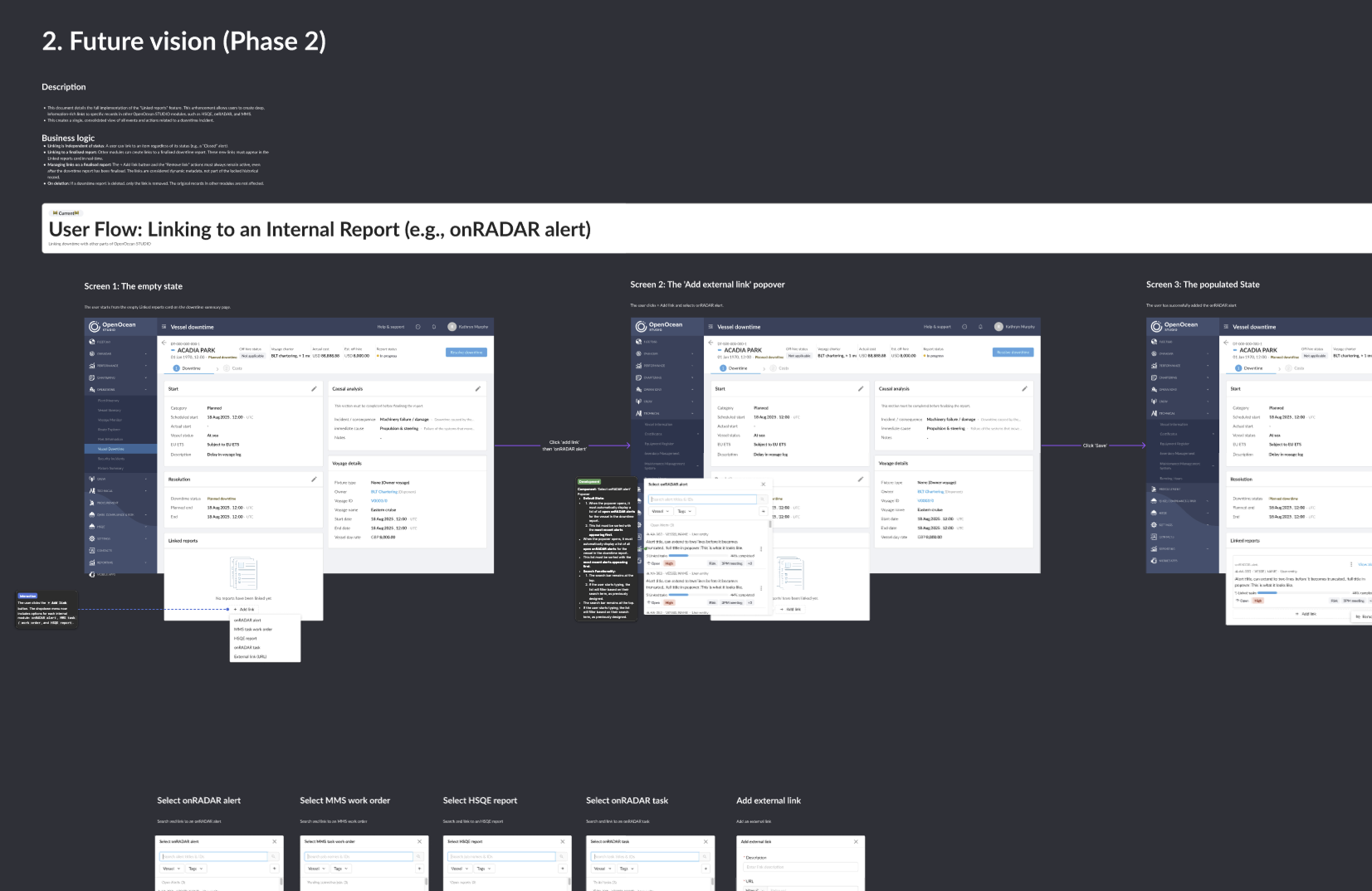
Future vision / Phase 2: exploratory links between a downtime event and a related internal report.